
Owen Doherty
Canny is the feedback-driven Pendo alternative
Pendo is a suite of product analytics tools. Its feedback tool, Listen, is one module among many.
Canny is built around customer feedback. It brings customer requests into one place, shows you the customers and revenue behind each one, and keeps everyone updated as you build.
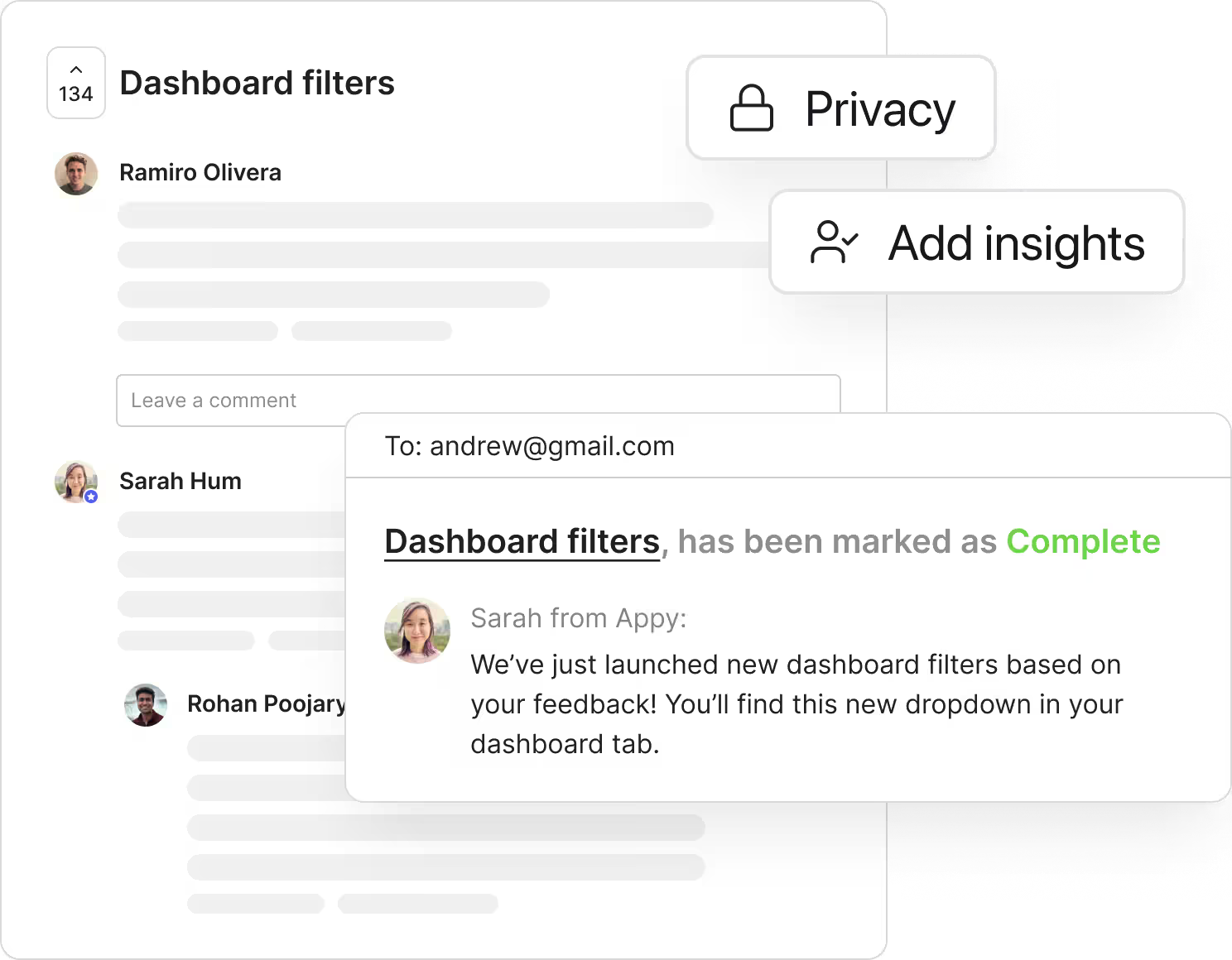






Quick look: Why teams choose Canny over Pendo for feedback


Built for feedback
Feedback management is the whole product, on every plan including Free.
One module in a larger suite
Listen comes with Pendo’s top paid plan or as an add-on.
Transparent pricing
Published plans, priced based on how many customers share feedback.
Quoted pricing
No published pricing. Median Pendo contract is $48,500 a year, per Vendr.
Duplicates merge themselves
Autopilot merges and groups duplicate feedback automatically.
Duplicates flagged for review
AI flags duplicates and suggests links, and your team accepts or rejects each one.
AI captures feedback for you
Autopilot reads support chats, sales calls, and public reviews.
In-app first
Collected from in-app tools and select external sources.
Revenue and deal data on every request
See account ARR, open opportunities, and closed-lost revenue behind each feature.
Account-level revenue
Limited to account fields like ARR.
Collaborative customer portals
Requests appear on your portal right away, so users can vote and comment.
Curated portal
Your team decides which ideas appear in the in-app portal.
Easy to set up and use
Most teams are up and running in a day.
Steeper learning curve
Lengthy onboarding and setup.
Canny compared to Pendo Listen
Listen is where Pendo customers collect feedback, turn it into ideas, and plan roadmaps. It sits inside Pendo’s analytics suite and is built around the people using your product. Feedback is tied to the visitor and account records Pendo keeps from your app. Pendo retired its classic Feedback module on August 1, 2026, and Listen replaced it.
Canny is focused on feedback wherever it comes from, including the sales calls, support chats, and reviews that happen outside your app. It connects that feedback to the deals and accounts behind it and keeps your sales and CS teams in the loop.
Teams that moved from Pendo report that their sales and CS teams struggled to log feedback consistently, and that requests about different products were hard to see in one place.
Capture feedback from the tools your team already uses
Pendo built Listen around in-app capture: polls, surveys, and a feedback form inside your product, plus select external integrations.
Canny starts with the conversations your team is already having. Autopilot reads support chats, sales calls, and public reviews. It captures each feature request and adds it to the right product area with customer info attached. Each request links back to the original conversation.
"Canny’s Autopilot ensures feature requests never fall through the cracks. We’ve seen an 80% increase in requests logged since introducing Autopilot."

Duplicate feedback: how Canny and Pendo Listen handle it
Both tools use AI to manage duplicates and organize feedback into product areas. In Listen, AI flags duplicates and suggests which idea a piece of feedback belongs to, and someone on your team accepts or rejects each suggestion.
In Canny, Autopilot merges and groups duplicates automatically, so each request shows every customer who asked for it without anyone sorting it by hand.
See the customers and revenue behind each request
Both tools let you connect revenue to your feedback. Pendo lets you segment feedback by account fields from Salesforce, like ARR or lifecycle stage. Its Explore AI can rank feedback themes by account ARR.
Canny shows account ARR too, and also connects to Salesforce and HubSpot to link each request to the deals behind it. Built-in reports highlight the features tied to open opportunities and closed-lost revenue. This lets you build the features that close deals and keep your biggest accounts from churning.
"A feature affecting $10K of existing revenue could easily beat one with $500K of opportunity value, because there was no way to see the difference."

Freeman Cherng
AI Customer Success Manager at Assembled
Build a feedback community with your customers
Pendo’s ideas portal is curated. Customers can submit feedback through a form, but the ideas they see and vote on are the ones your team chooses to show.
Canny’s Portal is more open. Requests show up as soon as customers submit them, so others can find them, vote, and add their own use cases in the comments. Your team replies in the same thread. You can use Smart Replies to ask customers follow-up questions automatically, so you get the detail you need without chasing it.
Your portal can be public or limited to specific customers. Everything customers share there also gets an internal version in Ideas.
“We started looking for a tool with a public roadmap where the community could interact with us and also between each other. It was really important for us to give them a place where they can chat about feature requests and what’s missing in the product.”

Aurélien Georget
CPO at Strapi
Keep customers and account owners in the loop when you ship
Both tools email customers when the status of their request changes, post updates to team channels, and sync status with Jira.
Canny also routes those updates to the people who sell to and support each customer. When a feature ships, each account owner whose customers asked for it gets a Slack alert.
You can also publish detailed product announcements in the Changelog tool. Entries link back to the requests they address.
Canny vs Pendo integrations
Canny reads feedback from more of the tools your customers already use, and syncs with whichever project management tool your engineers work in.
Feedback sources
20+ sources Autopilot reads, including Intercom, Zendesk, Gong, Zoom, Google Meet, Help Scout, Freshdesk, and 10 review sites and marketplaces
Feedback sources
In-app polls, surveys, and forms, plus Zendesk, Gong, Zoom, Microsoft Teams, Slack (beta), and Salesforce (beta)
Project management
Jira, Linear, GitHub, ClickUp, Asana, and Azure DevOps, each with status sync
Project management
Jira
CRM
Salesforce and HubSpot, down to opportunities and deals
CRM
Salesforce, at the account level
Get your team onboarded in a day
Canny is easy to set up, connect to your feedback sources, and configure your portal.
"Getting Canny set up couldn’t have been easier. We started with a blank canvas and allowed our users to paint the rest."

Zeb Evans
Founder, CEO at ClickUp
Reviewers describe the Pendo platform as complex to set up, hard to learn, and not intuitive for day-to-day work.
“Pendo is not simple to set up and configure; dedicated resources are needed to setup/manage.”
Canny is less expensive than Pendo
Pendo has a free plan, but Listen isn’t part of it. Listen comes with Pendo’s top paid plan or as an add-on to lower plans, both quoted by sales, and pricing is based on your product’s monthly active users. Vendr has tracked nearly 600 Pendo purchases, and the median contract across all of Pendo’s products is $48,500 a year.
“I dislike manual tagging, and the fact that you have to pay extra for features like listen and replay.”
Canny publishes its pricing and charges per tracked user (customers who’ve shared feedback). Start on the free plan, or sign up for Pro from $79 a month, billed annually, without talking to sales. Business plans are tailored to your needs.
Free
$0
/ mo
Pro, starts at
$79
/ mo
More details and custom pricing options available
View pricingNeed a demo or custom pricing? Talk to our team.
See Canny on your own feedback
Start free in minutes, or book a demo to see how Canny handles feedback from your own customers.
Frequently asked questions
What’s the difference between Canny and Pendo Listen?
Pendo Listen is the feedback module inside Pendo’s product analytics suite, included with its top paid plan or sold as an add-on, with pricing quoted by sales. Canny is a standalone feedback platform with published pricing that captures requests from support, sales, and review sites, merges duplicates automatically, and shows the revenue behind each one.
When is Pendo the better choice?
If your main need is product analytics and in-app guides, with feedback as a smaller part of the job, Pendo covers that in one suite. You can also keep Pendo for analytics and guides and use Canny for feedback alongside it.
Can Pendo poll and NPS responses come into Canny?
Yes. Depending on your Pendo plan, poll and NPS responses can go out through webhooks or Pendo’s Zapier integration, and Canny’s API or Zapier brings them in.
We used Pendo’s classic Feedback. Can we bring our history over?
Yes. If you exported your classic Feedback data before Pendo’s November 1, 2026 deletion date, send it to us and we’ll migrate it into Canny within 48 hours.
How is Canny priced?
Per tracked user, meaning the customers who’ve given feedback (typically 1 to 5% of your user base) rather than everyone who uses your product. Pro starts with 100 tracked users and includes 10 admin seats, and every plan is listed on our pricing page.
What kinds of teams use Canny?
Mostly B2B SaaS product teams, from early-stage startups to large companies, who want customer feedback connected to the accounts and revenue behind it.